
The world marks the International Day of International Criminal Justice, commemorating the adoption of the Rome Statute in 1998, the treaty that established the International Criminal Court (ICC). The Court plays a pivotal role in prosecuting perpetrators of the gravest international crimes, including genocide, crimes against humanity, war crimes, and the crime of aggression, thereby contributing to the protection of civilians and the reinforcement of the rule of law.
This year's International Day of International Criminal Justice comes as the Israeli Occupying Forces continues its genocidal campaign against the Palestinian people, now entering its third year. To date, more than 73,000 Palestinians have been killed, entire governorates and cities have been erased from the map, and approximately 80% of buildings and civilian objects—including economic, social, cultural, and health facilities, as well as critical infrastructure—have been destroyed.
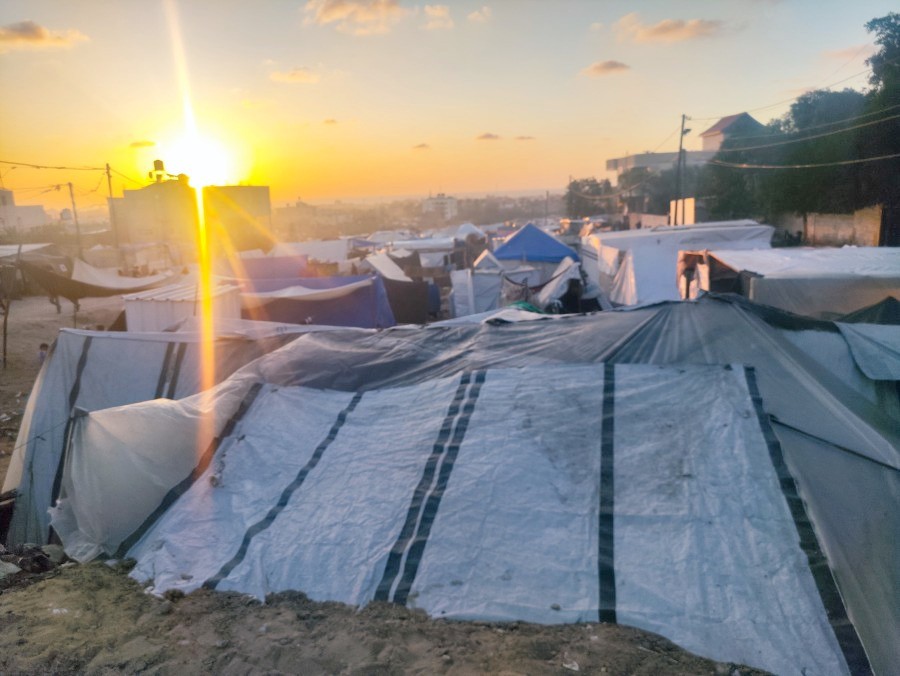
The remaining Palestinian population has been forcibly confined to approximately 30% of the total area of the Gaza Strip, where the vast majority of whom are are living in makeshift tents in catastrophic humanitarian conditions that lack even the minimum requirements for a dignified human life. These conditions are marked by the spread of disease and epidemics, the growing number of missing persons, and the complete absence of the minimum requirements for a dignified life. This constitutes one of the most horrific genocidal campaigns of the modern era, unfolding amid the failure of the international system to fulfil its obligations under international law—particularly its duty to protect civilians safeguarded by international humanitarian law—while Israel's relentless military assault continues to claim civilian lives.
This genocidal campaign could not have continued with such brutality without the inaction and complicity of the international community, particularly influential States seeking to impose their political will on the international legal order and its institutions responsible for upholding international law and ensuring accountability, including the International Criminal Court, the United Nations Special Rapporteurs on human rights, and human rights organizations. Such conduct has emboldened Israel to persist in committing grave international crimes with complete disregard for the international justice system.
As part of ongoing efforts to undermine the International Criminal Court and weaken the international justice system, United States Secretary of State Marco Rubio recently pledged to dismantle the ICC, claiming that it poses a threat to U.S. sovereignty. He further announced the launch of a diplomatic campaign aimed at pressuring States Parties to withdraw from the Court, while threatening its officials with sanctions and travel restrictions.
The United States has also expanded its sanctions targeting the ICC. These measures follow earlier sanctions imposed against two ICC judges—Gocha Lordkipanidze of Georgia and Erdenebalsuren Damdin of Mongolia—as well as Francesca Paola Albanese, the United Nations Special Rapporteur on the situation of human rights in the Occupied Palestinian Territory, and three Palestinian human rights organizations: Al Mezan Center for Human Rights, the Palestinian Centre for Human Rights (PCHR), and Al-Haq.
Furthermore, the United States announced sanctions against four current officials of the International Criminal Court: Canadian Judge Kimberly Prost, French Judge Nicolas Guillou, Deputy Prosecutors Nazhat Shameem Khan of Fiji and Mame Mandiaye Niang of Senegal. The U.S. administration justified these measures on the grounds that the officials had directly participated in investigations or prosecutions involving individuals whom Washington and Israel consider to be protected, describing the Court's actions as part of what it called the ICC's "illegitimate" efforts against the United States and Israel.
By shielding those responsible for genocide from accountability, Palestinian civilians are effectively deprived of the protection afforded to them under international law and exposes them to death on a daily basis. At the same time, it emboldens Israel to openly proclaim and implement policies aimed at the destruction of the Palestinian people in the Gaza Strip and the seizure of Palestinian land in the occupied West Bank, including Jerusalem.
The latest example came on 13 July 2026, when Israeli Minister of Defense Israel Katz, speaking to Israel's Channel 14 during a visit to northern Gaza, declared: "I am proud of the destruction that has taken place; it gives me a good feeling, and I intend to establish three military-style settlement outposts in the Gaza Strip."
Despite the Sharm El-Sheikh Agreement and the ceasefire that entered into force on 11 October 2025, Israel's genocidal campaign against the Palestinian people has continued unabated. Since the ceasefire, Israeli occupying forces have killed 1,110 Palestinians and injured 3,599 others. They have also continued land-levelling operations, artillery shelling, and live-fire attacks in the eastern areas of the Gaza Strip. At the same time, Israel continues to arbitrarily detain thousands of Palestinians without charge or trial, subject them to torture and other forms of cruel, inhuman, or degrading treatment, impose inhumane detention conditions, while the suffering of families of missing persons continues to deepen and the withholding of Palestinian bodies persists.
The Rome Statute, through which the International Criminal Court was established, was designed to ensure accountability for perpetrators of the gravest international crimes—including genocide, war crimes, crimes against humanity, and the crime of aggression—with the objective of ending impunity, advancing international justice, and protecting the rights of victims. Today, however, the international criminal justice system is facing mounting pressure aimed at undermining its independence whenever it seeks to address crimes committed by Israel, This reflects a pattern of double standards and selective application of international law, whereby the international community has demonstrated far greater resolve in responding to certain conflicts, such as the war in Ukraine, than it has in addressing the crimes committed against the Palestinian people.
The international community, particularly the Member States of the European Union, must recognize that the current threat extends beyond the International Criminal Court itself. It targets everyone who advocates for justice and accountability. Any failure to act—or any accommodation of the policies pursued by the United States administration—will have serious consequences for the international legal order as a whole.
Immediate action is therefore required to protect the International Criminal Court, its judges, the United Nations Special Rapporteur on the situation of human rights in the Occupied Palestinian Territory, and the Palestinian human rights organizations that have been subjected to sanctions. They must be enabled to carry out their mandates independently and effectively, and international cooperation with these institutions must be strengthened. What is needed today is not merely expressions of solidarity, but concrete measures to preserve and reinforce the international justice system.
On the International Day of International Criminal Justice, Al Mezan Center for Human Rights affirms that the continued denial of justice to Palestinians will only lead to the expansion of grave international crimes, an ever-increasing number of victims, and the transformation of this part of the world into a landscape of death and human suffering. It will also stand as enduring evidence, recorded in the pages of history, of the international community's failure to fulfil its legal and moral responsibilities, its inability to protect civilian lives, and its obstruction of international justice, particularly the mandate of the International Criminal Court.
Al Mezan unequivocally condemns all sanctions and punitive measures imposed against judges and officials of the International Criminal Court, and calls for the Court to be enabled to continue its work as an independent, impartial judicial institution vested with the mandate to deliver international criminal justice.
This day serves as an important opportunity to renew the international community's commitment to the principles of justice and accountability, to uphold the rights of victims, and to strengthen efforts aimed at preventing crimes that threaten international peace and security. Al Mezan further underscores the importance of international cooperation in combating impunity and promoting a world founded on justice, human dignity, and respect for human rights.
Al Mezan calls upon the international community to fulfil its legal and moral responsibilities toward victims in the Occupied Palestinian Territory by ensuring Palestinians' access to justice, guaranteeing their right to an effective remedy and full reparation, and activating international accountability mechanisms to prosecute those responsible for the crime of genocide in the Gaza Strip. The Center further calls for an end to the prevailing culture of impunity, decisive action to halt Israel's grave violations of international law, and effective measures to ensure Israel's compliance with its obligations under international law.
Al Mezan further calls upon the High Contracting Parties to the Fourth Geneva Convention, all bodies mandated to ensure respect for and enforcement of international law, and other relevant international actors to take effective and concrete measures to end the suffering of Palestinian victims, stop Israel's ongoing military offensive, and ensure accountability for all perpetrators of international crimes.


