
Palestinian patients in the Gaza Strip continue to face a series of arbitrary measures and restrictions imposed by the Israeli authorities on the movement of Palestinians through the Rafah Crossing, exacerbating their suffering and contributing to the deterioration of their physical and psychological health. The requirement imposed by the Israeli authorities to obtain security clearance as a condition for travel constitutes a serious and grave obstacle. Patients and their companions are forced to wait for responses to their applications, which are submitted by the Ministry of Health through lists transmitted via the World Health Organization (WHO). In many cases, these applications are rejected and patients are denied travel, despite medical documentation confirming their urgent need for treatment, particularly those suffering from advanced and life-threatening conditions such as cancer and heart disease.
According to the Center’s ongoing monitoring of the conditions of patients and the movement of travelers through the Rafah Crossing, the Israeli authorities have closed the Beit Hanoun “Erez” Crossing since October 2023. In May 2024, the Israeli authorities took control of the Rafah Crossing during their ground offensive against Rafah Governorate and subsequently closed it, preventing residents from leaving the Gaza Strip altogether, including patients, students, and holders of residency permits. The crossing remained closed for more than a year and a half. In February 2026, the Israeli authorities permitted a limited number of patients and injured persons to resume travel, despite the large number of patients holding urgent and emergency medical referrals who require immediate access to treatment outside the Gaza Strip.
With regard to the suffering of Palestinian patients, (E.H.), a 42-year-old resident of Gaza, told the Center’s lawyer on 18 August 2026:
“I have been suffering from weakness of the heart muscle for 10 years, as well as an enlarged spleen and the early stages of liver fibrosis. Doctors in Gaza implanted a pacemaker to regulate my heartbeat. However, during the genocidal war on Gaza, it became clear that the device required programming and maintenance. My heart stopped five times during the war, which required my transfer to hospital. There, doctors conducted the necessary examinations and, at the beginning of June 2026, decided that I required a medical referral for treatment outside the Gaza Strip. The Ministry of Health included my name on the lists submitted to the World Health Organization, which, in turn, referred it to the Israeli authorities. I then began a long period of waiting. However, I was informed at the beginning of July 2026 that the authorities had decided to deny me permission to travel. My health condition is now deteriorating, and there is a real danger to my life…”
Earlier, (F.A.), a resident of Khan Younis Governorate, a mother of four children whose husband is a person with a disability, stated:
“I have been suffering from cancer for three years. As a result of the war, the lack of food, and the unavailability of medicines, my health condition has progressively deteriorated. There is no treatment available in the hospitals of the Gaza Strip to relieve or alleviate my pain. I obtained a medical referral to receive treatment outside the Gaza Strip a long time ago, but I am still waiting to travel. My condition continues to worsen. I do not know when I will be able to travel, or whether I will still be alive by then…”
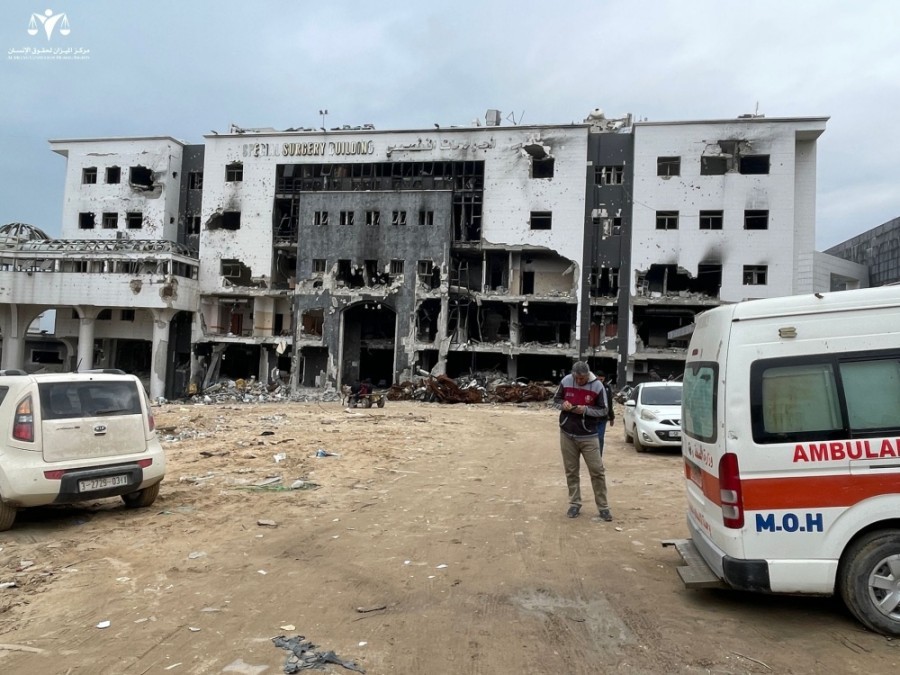
The suffering of Palestinian patients is further exacerbated by the continued denial of access to the medical equipment, supplies, and capabilities required in the Gaza Strip, in addition to the destruction of a large number of major hospitals, including Al-Shifa Hospital in Gaza City, Abu Yusuf Al-Najjar Hospital in Rafah, the European Gaza Hospital in Khan Younis, and Kamal Adwan Hospital in northern Gaza. The destruction of these hospitals has deprived them of their ability to provide medical and health services. In addition, hundreds of doctors and nurses have been killed or detained. Meanwhile, the Palestinian Ministry of Health warned on Monday of the consequences of the shutdown of most oxygen-generating stations, noting that shortages of medical supplies and spare parts required for maintenance are threatening the lives of dozens of patients and children in intensive care units and neonatal incubators.
Al Mezan Center for Human Rights strongly condemns the restrictions imposed by the Israeli authorities on the freedom of movement of Palestinian civilians, particularly patients, injured persons, and their companions. The Center warns of the grave consequences of continuing to prevent, obstruct, or delay their travel, given the serious threat such measures pose to their lives, particularly in light of the advanced and critical medical conditions requiring urgent access to treatment. The Center further stresses that these restrictions constitute clear violations of international human rights standards and international humanitarian law, particularly the right to freedom of movement and the right to health and access to medical treatment.
Al Mezan Center for Human Rights calls on the international community to assume its legal and moral responsibilities towards the population of the Occupied Palestinian Territory, particularly patients and injured persons. The Center calls for the adoption of all necessary measures to enable them to travel and access hospitals, facilitate the entry of the medical equipment and supplies required, urgently rehabilitate and restore hospitals, lift all restrictions imposed on the health sector, open all crossings, and ensure respect for the provisions of international law.


