
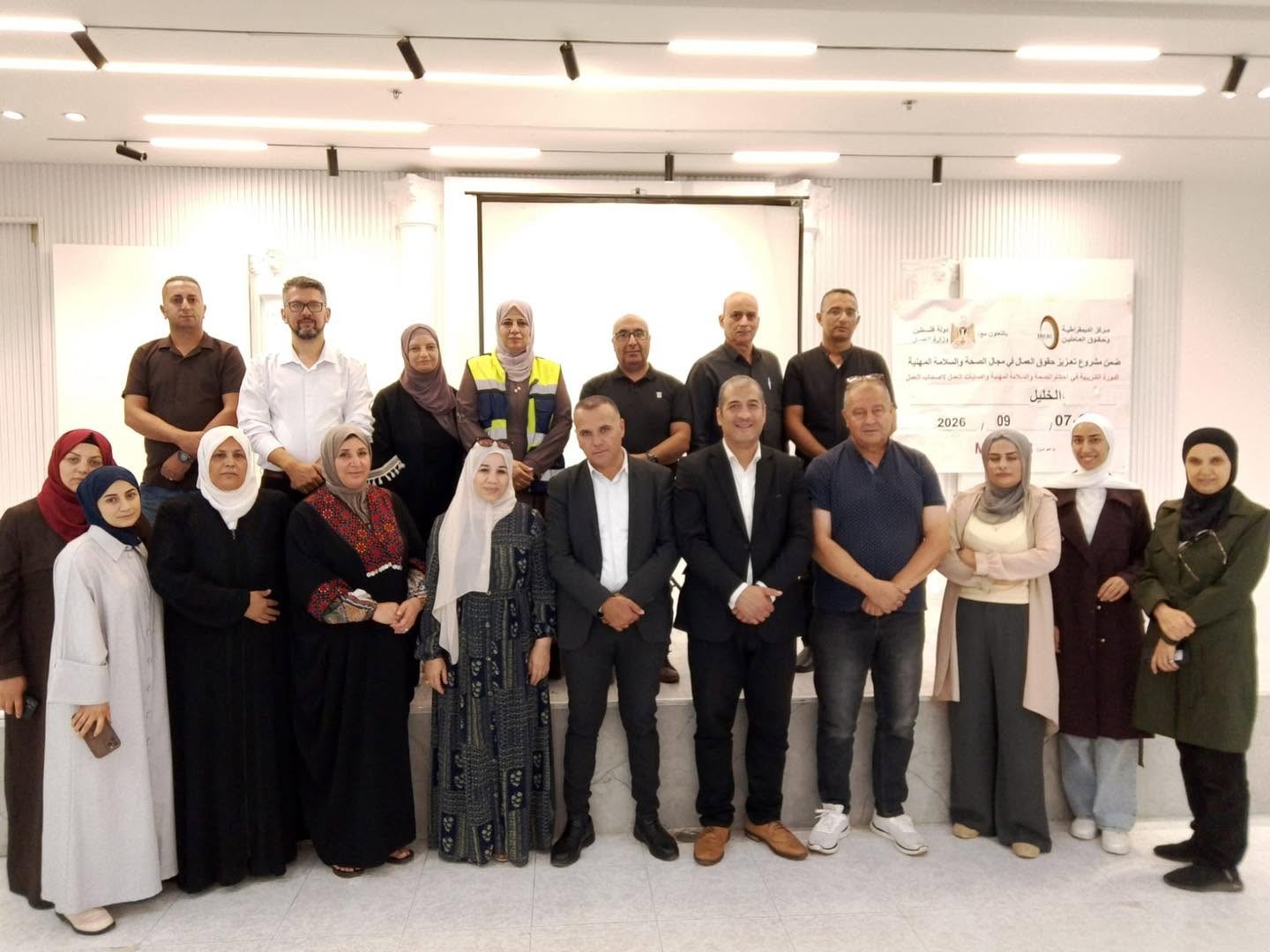
The Democracy and Workers’ Rights Center (DWRC), in cooperation with the General Directorate of Occupational Safety and Health at the Palestinian Ministry of Labour, conducted four of eight planned training courses on occupational safety and health. The courses brought together 86 employers, employers’ representatives, and occupational safety and health supervisors from the governorates of Jenin, Ramallah, and Hebron.
The participants included 23 women and 63 men representing a range of establishments and sectors, including civil society organisations, municipalities, private companies, factories, and universities. The courses aimed to promote workers’ occupational safety and health rights and contribute to improving working conditions within establishments.
The training addressed the concept of occupational safety and health, employers’ responsibilities, and the relevant Palestinian legislation, including Palestinian Labour Law No. 7 of 2000, Public Health Law No. 20 of 2004, regulations governing occupational safety and health and workplace injuries, and the Decree-Law on Occupational Safety and Health Committees and Supervisors. It also covered methods for identifying and assessing occupational hazards using a risk matrix.
The second day of the training focused on first aid, including first-aid teams, injury-reporting procedures, types of injuries, and appropriate responses to different cases. In cooperation with the Palestinian Civil Defence, the training also addressed fire prevention, evacuation procedures, and public safety requirements.
The sessions were delivered by DWRC Legal Adviser Samah Farakhneh, representatives of the General Directorate of Occupational Safety and Health at the Ministry of Labour and its district offices, and specialists from the Palestinian Civil Defence.
Participants recommended intensifying training on occupational safety and health, workplace injuries, and first aid, particularly resuscitation and responses to cases of fainting, fractures, and burns. They also called for more frequent field visits by labour inspection teams and occupational safety and health departments, the activation of the Decree-Law on Occupational Safety and Health Committees and Supervisors, and the clarification of some of its provisions through implementing regulations.
Following the courses, several participants contacted DWRC for consultations on occupational safety and health, working conditions, and provisions of Palestinian labour law related to wages, leave
entitlements, and disciplinary regulations. Participants also received specialised awareness materials and certificates of participation.


