
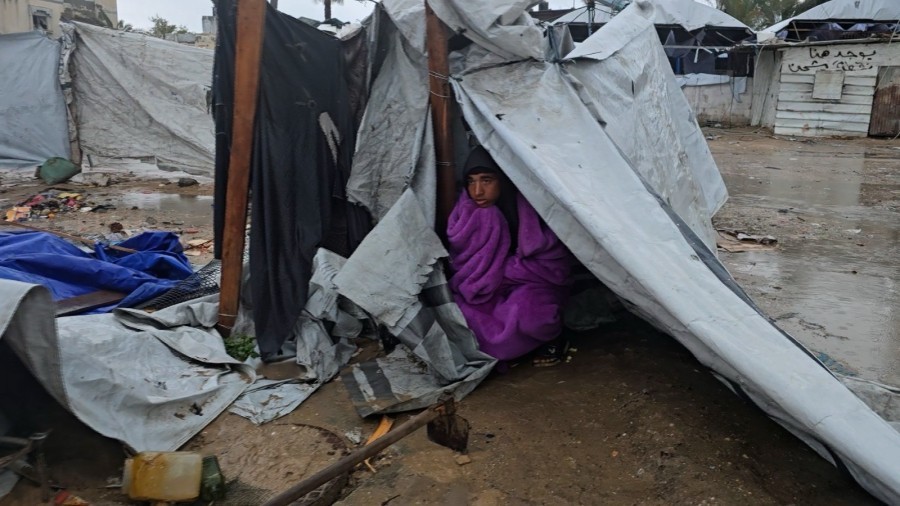
Al Mezan Center for Human Rights warns of an imminent humanitarian, health, and environmental catastrophe as winter approaches amid the continued genocidal war against civilians in the Gaza Strip for the third consecutive year. Hundreds of thousands of displaced persons remain in dilapidated tents that offer no adequate protection from the severe winter cold, rain, and wind, and fail to provide even the minimum conditions necessary for safe and dignified living. This is compounded by continued restrictions on the entry of humanitarian assistance, fuel, and medical supplies, further aggravating the vulnerability of the civilian population and leaving civilians exposed to cold, hunger, and disease without adequate means of protection or an effective humanitarian response. These conditions place civilians at grave risk of a large-scale health catastrophe, with children, women, older persons, and patients among those most vulnerable to its consequences.
The increasingly grave conditions accompanying the onset of winter are further compounded by the collapse of essential infrastructure, the disruption of sewage networks, the accumulation of solid waste, and the flow of rainwater and its mixing with untreated wastewater in displacement areas. These conditions threaten to turn places of civilian displacement into environments conducive to the spread of disease and epidemics, at a time when the healthcare system has been severely degraded and is unable to respond adequately to widespread outbreaks. Leaving civilians to face extreme cold, contaminated water, and disease in dilapidated tents, amid the continued deterioration of humanitarian conditions, places their lives and health at serious risk. The continued failure to ensure adequate protection and address the essential needs of the civilian population raises grave concerns regarding compliance with the obligations to respect and ensure respect for international humanitarian law and to protect civilians from the effects of hostilities and conditions that endanger their lives.
According to UNICEF, nearly 84 per cent of the population – more than 1.76 million people – continue to live in overcrowded displacement sites or damaged and inadequate shelters.[1]
The latest estimates from the Shelter Sector indicate that 94% of the population of the Gaza Strip are in need of shelter assistance and non-food items; 58% face critical or catastrophic shelter needs; 84% of households face severe living constraints, including inadequate protection from weather conditions; and at least 11 children in the Gaza Strip, including infants, died from hypothermia over the past year.[2]
Jonathan Fitch, UNICEF Special Representative, stated: “For hundreds of thousands of children, winter is not simply a seasonal hardship”, “The winter months present yet another threat to children’s survival and wellbeing”. “Children are particularly vulnerable. Infants, young children and those with pre-existing health conditions face heightened risks from hypothermia, respiratory infections, waterborne diseases and other preventable illnesses”.[3]
Buildings and homes at risk of collapse also pose an additional and foreseeable threat to the lives and physical integrity of residents and displaced persons, amid the continued presence of large numbers of damaged structures resulting from the extensive destruction inflicted on buildings and infrastructure. Last week, a damaged building collapsed on its occupants in Gaza City, killing 21 civilians, most of them children and women. The risks posed by such structures are further aggravated as winter approaches, as heavy rainfall, strong winds, and moisture may exacerbate existing structural damage, increasing the likelihood of partial or complete collapse and exposing the lives of residents and displaced persons in their vicinity to further danger.
According to the latest statistics, the number of hazardous buildings has exceeded 2,000, including more than 250 buildings requiring urgent complete demolition using heavy machinery, and more than 870 buildings requiring partial demolition using manual labour and equipment. Geographically, the North Gaza Governorate has more than 520 hazardous buildings, including 42 requiring complete demolition and 88 requiring partial demolition; Gaza Governorate has more than 700 hazardous buildings, including 112 requiring complete demolition and 490 requiring partial demolition; the Central Governorate has more than 300 hazardous buildings, including 48 requiring complete demolition and 122 requiring partial demolition; and Khan Younis Governorate has more than 480 hazardous buildings, including 48 requiring complete demolition and 180 requiring partial demolition. In addition, 880 buildings are currently under study and assessment.[4]
A displaced resident, (M. D.), in Khan Younis, stated: “We are living in a house at risk of collapse. We live in constant fear, as the damaged building is no longer safe. Whenever there are strong winds or rain, we feel at risk and fear that parts of the building may collapse on us. We cannot afford to repair the house or move to a safer place. We fear that winter will pose an additional threat to my life and the lives of my children. We are now trying to move to a tent in Al-Mawasi out of fear that the house will collapse, especially after a building collapsed in Gaza a few days ago.”
At the same time, mounting pressure on the healthcare system is being compounded by the destruction of water and sewage networks and the absence of adequate sanitation facilities, which are essential to preventing the spread of disease and mitigating other public health risks. The deterioration of solid waste management and sanitation is further increasing risks to public health. From the beginning of September through 13 September, more than 304,000 health consultations were reported across 217 sites. Communicable diseases accounted for 13% of all consultations, with acute respiratory infections remaining the most frequently reported condition, followed by acute watery diarrhoea and skin diseases. Cases of impetigo, a highly contagious bacterial skin infection primarily affecting infants and young children, continued to be reported. A new case of acute flaccid paralysis was also reported, bringing the cumulative total to 21 cases in 2026.[5]
Al Mezan Center for Human Rights, while reiterating its condemnation of the continued genocide and the prevention of the entry of temporary shelters and shelter materials for displaced persons in the Gaza Strip, as well as heavy machinery and infrastructure equipment, particularly as winter approaches, warns of an escalating humanitarian and health catastrophe that threatens the spread of diseases and epidemics and exposes civilians to severe cold. This will place civilians, particularly children, at risk of death from hypothermia, disease, and the collapse of residential buildings.
The Center stresses the need to immediately open the crossings to allow the entry of equipment and materials necessary to address the effects of the approaching weather systems, mitigate the flow of rainwater and its mixing with dysfunctional sewage networks, and provide a safer environment for displaced persons, particularly children, women, and older persons, who face inhumane conditions that threaten their lives on a daily basis.
Accordingly, the Center calls on the international community to uphold its legal and moral responsibilities towards the population of the Gaza Strip and to take urgent action to ensure the protection of civilians amid the continued genocidal war and the deteriorating weather conditions expected during the winter. It further calls for the immediate and sustained opening of the crossings to allow the entry of shelter materials, heavy machinery, medical supplies, and the equipment necessary to rehabilitate essential infrastructure and preserve the lives of civilians in the Gaza Strip.
[2] Statement by the Ministry of Social Development


