
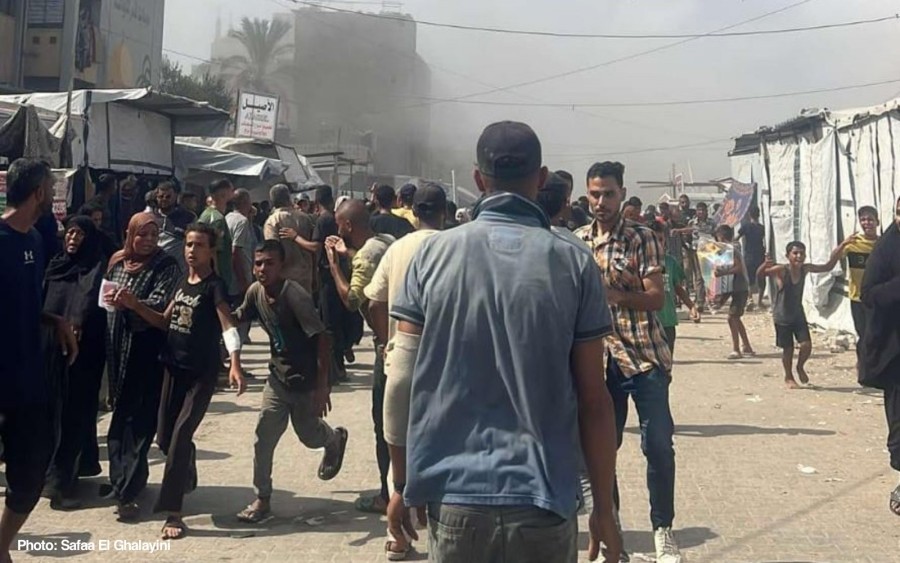
Israeli occupation forces continue to carry out military attacks across the Gaza Strip, escalating their targeting of civilians and displaced persons in residential homes, shelters, tents, and civilian gatherings. These attacks have resulted in the killing of 42 Palestinians and the injury of 218 others between 24 October and the time of issuing this statement. This comes amid a worsening humanitarian crisis, the continued deterioration of the healthcare system, and ongoing restrictions on the entry of humanitarian assistance, particularly medicines, medical supplies, electricity generators, fuel, and engine oils, posing grave risks to civilian lives.
According to field information, in the latest attacks, an Israeli drone struck the vicinity of the Electricity Company northwest of Nuseirat refugee camp in the central Gaza Strip at approximately 12:50 a.m. on Saturday, 31 October 2026, killing one Palestinian and injuring others. Another Palestinian succumbed to wounds sustained in an earlier bombardment in the Tal al-Hawa neighbourhood, southwest of Gaza City. At approximately 9:30 a.m. on the same day, four Palestinians were injured when Israeli military vehicles opened fire east of al-Maghazi refugee camp. Meanwhile, a fire broke out in a tent in al-Mawasi area of Khan Younis, resulting in the deaths of two children, identified as Habiba Zanoun and Aysal Abu Subaihan.
The eastern areas of Gaza City and western Beit Lahia also came under heavy artillery shelling. Israeli military vehicles opened fire northeast of Khan Younis and towards tents sheltering displaced families in al-Qarara al-Mawasi area and the Bir 19 area, while Israeli naval vessels fired towards the coastline of Gaza City. In the Abu Hamam area, east of Deir al-Balah, several military vehicles and bulldozers advanced beyond the Yellow Line, reaching the central Gaza Strip and moving south towards Wadi al-Salqa, southeast of Deir al-Balah. Israeli warplanes also bombed a tent near Taiba Towers, west of Khan Younis, killing one Palestinian and injuring others.
On Friday, 30 October 2026, several airstrikes targeted different areas across the Gaza Strip. These included an attack on a residential apartment in al-Ashqar building in the Sheikh Radwan neighbourhood, north of Gaza City, which injured several Palestinians. An Israeli drone also targeted a Palestinian in the al-Dahdouh area, southwest of Gaza City, killing him. In addition, a mobile phone charging point in the al-Maslakh area, west of Khan Younis, was targeted, injuring 16 Palestinians. Israeli occupation forces subsequently continued demolishing residential homes and buildings east of al-Masdar village in the central Gaza Strip, alongside heavy artillery shelling and gunfire from military vehicles directed at tents sheltering displaced families in the Qizan al-Najjar and Jorat al-Lout areas, south of Khan Younis.
A Palestinian citizen (W. S.), a resident of the al-Maslakh area near al-Mawasi in Khan Younis, reported:
"My family and I, consisting of my wife and our four children, have been living in a tent since we were displaced from Rafah. The area has become dangerous, as indiscriminate gunfire occurs every day. Out of fear that my children might be hit by gunfire, I have started moving with my family to sleep at night in another tent belonging to relatives in an area I believed to be safer. However, gunfire has now become constant and can happen at any time. Yesterday, we heard a powerful explosion that shook the area near us. It had struck a mobile phone charging point where people had gathered to charge their phones, resulting in a very large number of civilians being injured."
According to the Palestinian Ministry of Health, hospitals across the Gaza Strip received 42 Palestinians killed and 218 injured over the past seven days. This brings the total number of Palestinians killed to 1,581 and those injured to 5,711 since the signing of the Sharm El-Sheikh ceasefire agreement and its entry into force on 11 October 2025.[1]
As bombardment continues and the number of casualties rises, significant gaps remain in trauma, surgical and rehabilitation supplies, including IV fluids, anesthesia and surgical medicines, as well as microbiology and other specialized consumables. Specialized medicines for noncommunicable diseases, including Type 1 insulin analogues, remain in short supply, while diabetes screening is constrained by limited laboratory capacity and access to essential diagnostic services. Oncology diagnostics and imaging are severely compromised due a combination of ongoing restrictions on the entry of critical health supplies and equipment, collapse of the health sector with only 47 per cent of all health service points either partially or fully functioning across the Strip and limited capacity of the local health workforce.[2]
Breast cancer services are particularly constrained. The Gaza MoH reports approximately 664 documented breast cancer cases, including 105 newly documented cases in 2026. Major gaps include limited mammography and CT capacity,, lack of MRI services across the Strip, only four histopathologists, shortages of pathology supplies and consumables, and delays across diagnosis, treatment and referral pathways.[3]
Al Mezan Center for Human Rights strongly condemns the escalation of Israeli crimes, the continued targeting of civilians and the killing and wounding of Palestinians, attacks against civilian objects and infrastructure across the Gaza Strip, and the ongoing indiscriminate gunfire directed at civilians and their property. These acts are further aggravating the humanitarian crisis, particularly as winter approaches. The continued obstruction of humanitarian assistance, especially medical equipment, medicines, fuel, engine oils, and spare parts, constitutes a form of collective punishment and an integral part of the ongoing genocide perpetrated by Israeli occupation forces.
Accordingly, Al Mezan calls on the international community to take immediate and effective action to halt the ongoing and escalating massacres, exert pressure on Israeli occupation forces to end the crime of genocide, ensure the entry of humanitarian assistance, fuel, and medical equipment, and provide protection for civilians who have been subjected to genocide in full view of the international community for the third consecutive year.
[1] Palestinian Ministry of Health Statement.

