
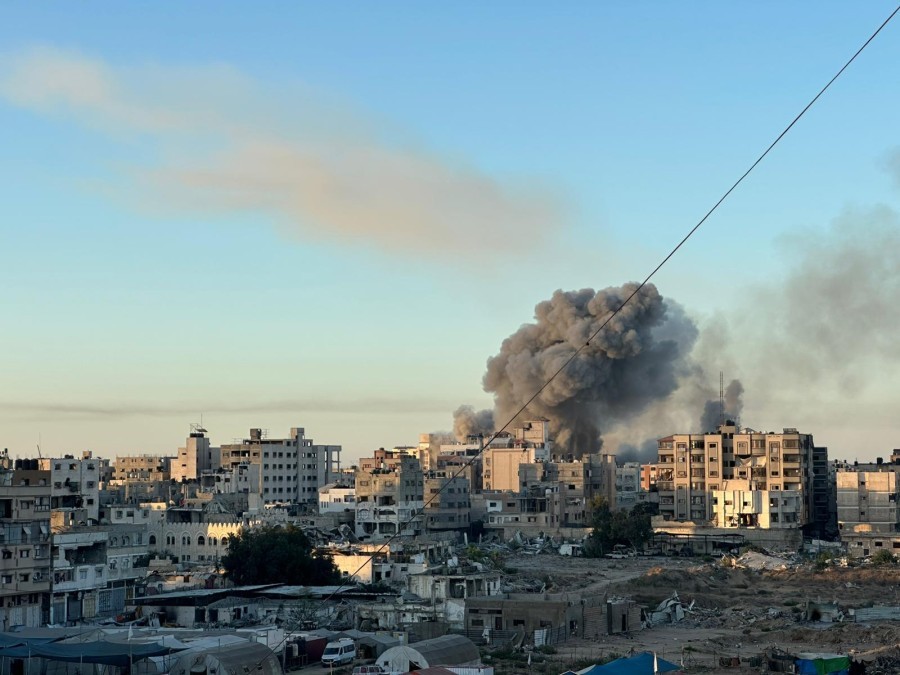
Al Mezan Center for Human Rights strongly condemns the continued commission of crimes by the Israeli Occupation Forces (IOF) in the context of the ongoing genocide against the Palestinian population in the Gaza Strip. The Center further condemns the marked escalation of military attacks targeting civilians in their homes, tents, shelters, and civilian gatherings. These attacks have intensified significantly in both frequency and scale over recent days and weeks, resulting in hundreds of Palestinians killed and injured and causing widespread destruction of civilian property and infrastructure.
Al Mezan also denounces the continuation and expansion of Israeli ground military operations across several areas in eastern Gaza, accompanied by the forcible displacement of civilians, the tightening siege imposed on patients and the wounded by preventing them from traveling abroad for medical treatment, the extensive destruction of hospitals and healthcare facilities, and the obstruction of the entry of medicines and essential medical supplies.
According to field information collected by Al Mezan, at dawn on Tuesday, 21 July 2026, six Palestinians were killed and others injured when an Israeli warplane targeted a residential house in Al-Sabra neighbourhood, east of Gaza City. Those killed were identified as Firas Al-Masri, his wife Salsabeel Al-Masri, and their four children: Naeem, Faryal, Salma, and Amira.
Later that same morning, an Israeli drone targeted a civilian vehicle in Al-Zahraa area, north of Al-Nuseirat Refugee Camp in the central Gaza Strip, killing two Palestinians, Raed Al-Amsi and Nabhan Al-Amsi, and injuring others. Shortly afterwards, another Israeli strike targeted the Young Women's Muslim Association building near Al-Samer Junction in Gaza City, killing four Palestinians: Abdullah Jaha, Mohammed Al-Hawari, Jihad Azzam, and Sobhi Saqallah.
Meanwhile, Israeli Occupation Forces continue to target unarmed civilians throughout the Gaza Strip. According to the Palestinian Ministry of Health, Gaza hospitals received 22 fatalities and 54 injured persons over the past 48 hours as a result of Israeli attacks across different areas of the Strip. Consequently, the number of Palestinians killed since the ceasefire agreement signed in Sharm El-Sheikh entered into force on 11 October 2025 has risen to 1,180, while the number of injured has reached 3,810.
According to A.D., a resident of Al-Nuseirat Refugee Camp in the central Gaza Strip:
"For the past two days, we have been hearing repeated explosions and the sounds of military incursions near the eastern areas of Al-Bureij. Yesterday, while I was on my way to Gaza City to buy some necessities, I heard a massive explosion close to where I was. I looked toward the opposite side of the street and saw a Hyundai Tucson engulfed in flames with smoke rising from it. Shortly afterwards, Palestinian Civil Defense and ambulance crews arrived and recovered the bodies of two people who had been killed. Their bodies were severely charred. I thank God that I am still alive, as I had been walking only a short distance from the targeted vehicle."
Meanwhile, the Israeli Occupation Forces continue their intensive aerial bombardment and artillery shelling of civilian homes and agricultural lands located outside the areas under Israeli military control, commonly referred to as the "Yellow Line." Through these attacks, Israeli forces are seeking to forcibly depopulate additional areas beyond this line in preparation for their seizure. They have already expanded their control over additional territory beyond the Yellow Line, particularly in Al-Zaytoun and Al-Shuja'iya neighbourhoods east of Gaza City. Israeli tanks have also carried out repeated incursions into eastern Al-Bureij, Deir Al-Balah, Bani Suheila, and Al-Qarara, accompanied by extensive bulldozing of civilians' lands and property.
Israeli forces have also established an earthen berm and a buffer zone extending for more than 20 kilometres inside the Gaza Strip in areas under their control. They continue to demolish and destroy residential blocks and homes located behind the earthen barrier and the Yellow Line. These measures are forcing civilians to flee repeatedly and crowd into displacement camps under extremely dire humanitarian and public health conditions.
According to M.D., a resident of Al-Qarara, east of Khan Younis:
"My family and I returned to Al-Qarara several months ago. We repaired what we could of our destroyed home and erected tents beside it. Together with our neighbours, we began bringing water and reclaiming nearby land for cultivation. However, we had to flee several times because of shelling and the approach of Israeli tanks, only to return whenever the area became relatively calm. Two days ago, we began hearing heavy gunfire and the movement of tanks close to our homes. We spent the entire night under intense bombardment, terrified for our children. The following morning, when I stepped outside, I found a large yellow concrete block placed directly in front of my house. As a result, my family, our neighbours, and I were forced to flee once again to the Al-Mawasi area of Khan Younis for fear that the army would establish positions in the area and target us."
At the same time, humanitarian conditions throughout the Gaza Strip continue to deteriorate as Israeli authorities persist in obstructing the entry of humanitarian assistance. The healthcare system has also suffered widespread destruction, rendering it incapable of meeting patients' needs, particularly as Israel continues to block the entry of medicines and essential medical equipment.
According to the Palestinian Ministry of Health, the healthcare sector is experiencing an unprecedented shortage of essential medicines, particularly those required by cancer patients. Life-saving medications, chemotherapy drugs, and supportive treatments have been completely depleted, while stocks of other essential medicines have reached critically low levels. As a result, oncology departments have become unable to admit new patients, including those requiring combination chemotherapy. Patients are increasingly vulnerable to severe complications and life-threatening infections due to the lack of immune-supporting injections, palliative medicines, pain relief, diagnostic and radiological equipment, as well as the continued denial of permission to travel for treatment. Approximately 4,000 cancer patients, out of 11,000 who have already obtained medical referrals for treatment abroad, remain stranded awaiting permission to leave the Gaza Strip.
According to F.A., a resident of Khan Younis in the southern Gaza Strip and a mother of four whose husband has a disability:
"I have been living with cancer for three years. Because of the war, food shortages, and the lack of medicines, my condition has steadily worsened. There is no treatment available in Gaza's hospitals to relieve or even ease my pain. I received a medical referral to obtain treatment abroad a long time ago, yet I am still waiting for permission to travel. My condition continues to deteriorate every day. I do not know when I will be allowed to leave, or whether I will still be alive by then."
Al Mezan Center for Human Rights strongly condemns the ongoing crimes committed by the Israeli Occupation Forces, including the escalating attacks targeting civilians in their homes, tents, shelters, and civilian gatherings, as well as the deliberate exacerbation of the humanitarian and healthcare crisis as a form of collective punishment and an integral component of the ongoing genocide against the Palestinian population in the Gaza Strip. The Center warns that the continued silence of the international community and its failure to take urgent and effective action to halt these unprecedented crimes will come at the expense of the lives of hundreds of thousands of innocent civilians.
Accordingly, Al Mezan calls on the international community to take immediate and effective action by exerting genuine pressure on the Israeli Occupation Forces to cease all military attacks against civilians and civilian property; immediately and unconditionally open all border crossings; ensure that patients are allowed to travel abroad to access life-saving medical treatment; and facilitate the unrestricted entry of humanitarian aid, fuel, medicines, medical equipment, and all other supplies indispensable to the survival of the civilian population.


