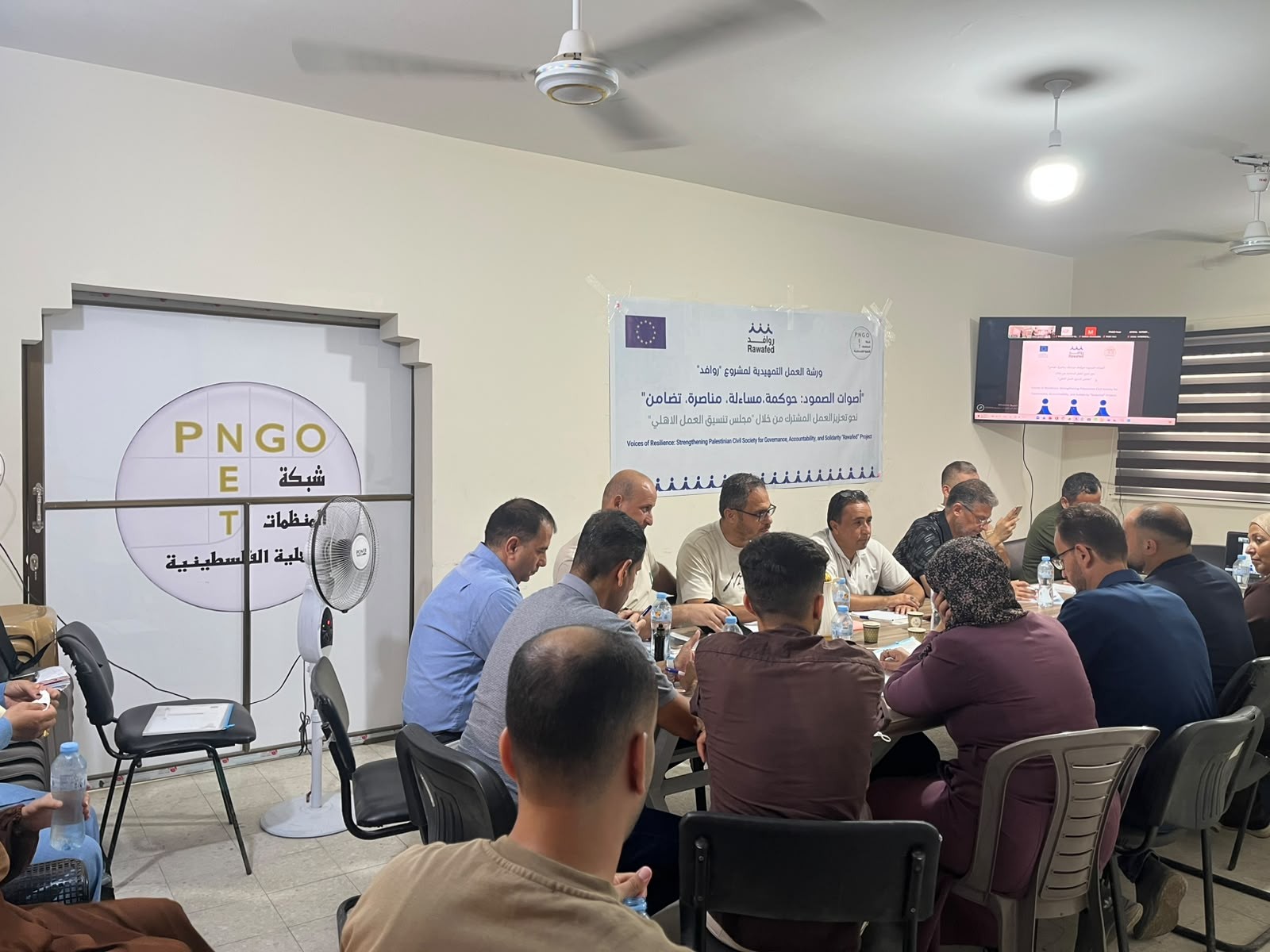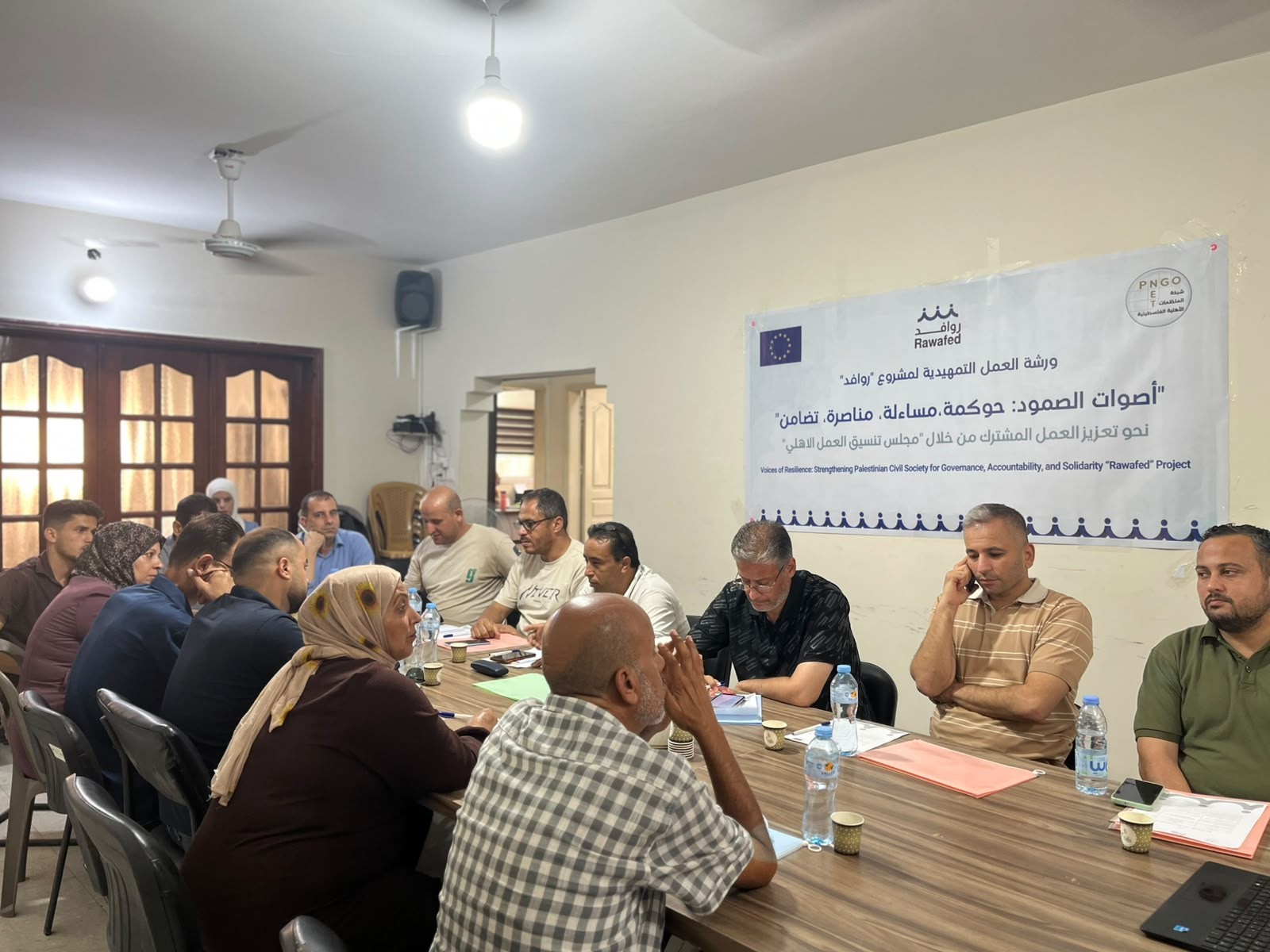
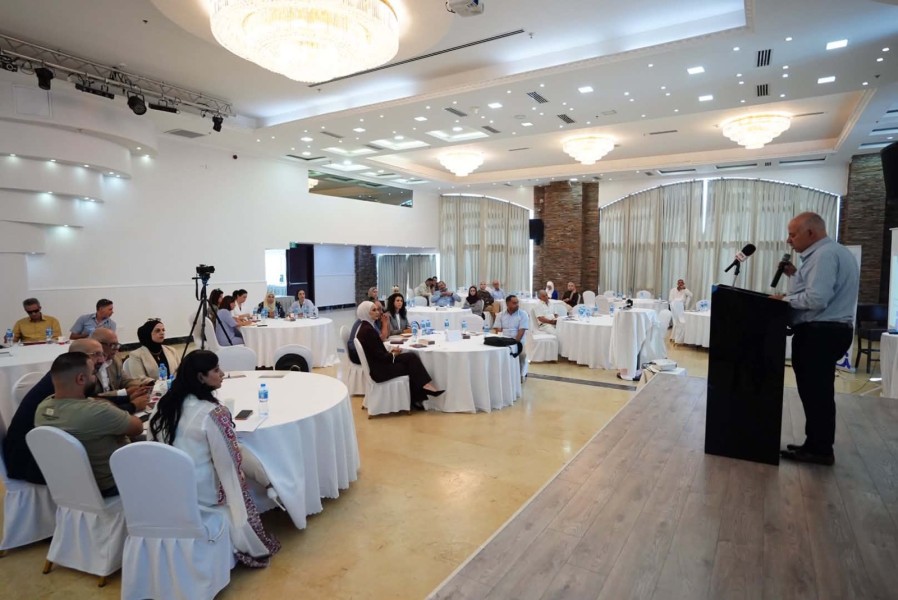
Ramallah / Gaza
The Palestinian Non-Governmental Organizations Network (PNGO) in the West Bank and the Gaza Strip launched this morning, Monday, the project "Rawafed: Voices of Resilience — Governance, Accountability, Solidarity, and Advocacy," funded by the European Union. The project aims to strengthen civil society organizations by activating the Civil Society Coordination Council, which comprises the Palestinian NGOs Network, the Union of Charitable Societies – Jerusalem, the Palestinian National Institute Non-Governmental Organizations, and the General Union of Charitable Societies, in the presence of a broad gathering of civil, official, and community institutions and European Union partners.
PNGO announced the launch of the project in the West Bank, the Gaza Strip, and Jerusalem, which is based on enhancing collective action among active civil society organizations through the establishment of coordination mechanisms at both the local and national levels, amid the current difficult and unprecedented conditions, the repercussions of the war crime committed against the Gaza Strip, and the restrictions and hardships imposed on the West Bank and Jerusalem.
The introductory workshop for the launch of the project opened with a speech by the Chairman of the Civil Society Coordination Council and Chairman of the Coordinating Committee of the PNGO, Munjed Abu Jish, during which he presented an overview of the Council, its components, and its significance as a comprehensive framework for representing civil institutions. He noted that it is based on strengthening partnership among umbrella networks and contributes to shaping public policies, protecting the space and independence of civil work, and enhancing joint action among grassroots and local institutions and integrating their work at the national level through the Council. This comes at an exceptional phase that requires a serious review ways of working and a transition to collective action, given the increasing pressure and challenges facing Palestinian society, and the need to raise the level of joint coordination among all parties toward serious positions that address current issues with a unified community voice. He also emphasized the importance of strengthening resilience and protecting targeted areas and vulnerable groups, given the diversity of the Civil Society Coordination Council, which allows for work with all official sectors and the private sector on the basis of partnership, and for organizing internal affairs away from competition, in light of the reality of the Palestinian people and the existential war they are enduring, and the need to increase work with targeted areas despite the financial siege, particularly in the areas of women, Bedouin communities, and youth.
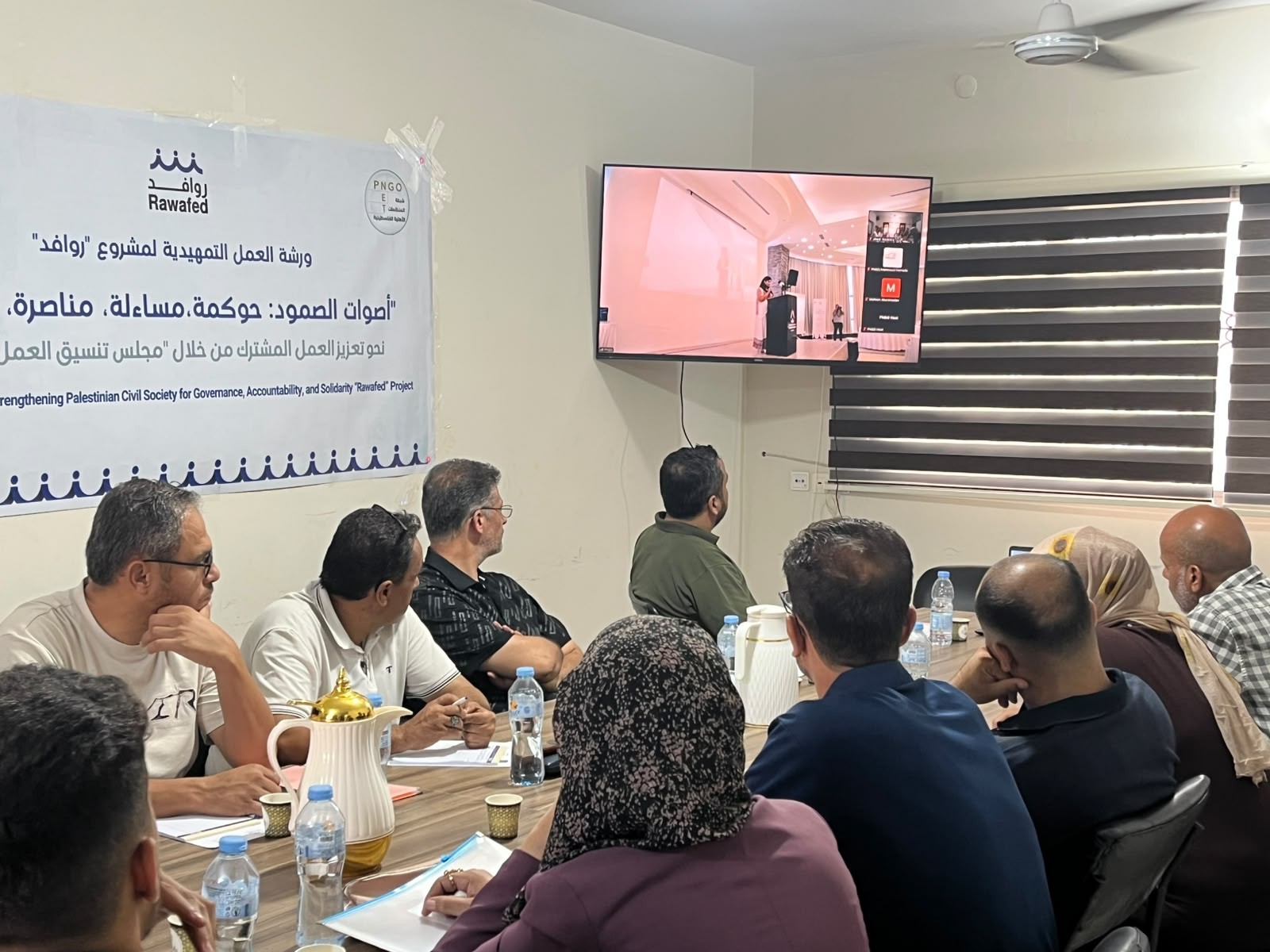
Mohammed Salha, the Network's Coordinator in the Gaza Strip, affirmed in a speech delivered via Zoom the catastrophic situation in the Gaza Strip and the challenges witnessed in the West Bank. He considered that Rawafed project represents an important contribution to developing networking and communication and increasing coordination among all institutions within the civil space, despite the limited capacities to provide services due to the genocidal war and the destruction that has befallen large areas of the Strip. He added that the project, funded by the European Union, also represents a window for developing the capacities of civil society in many areas, particularly reconstruction and recovery, which require genuine partnership with civil society. He stressed the importance of protecting the civic space, broadening the base of participation, and providing an enabling environment that serves to develop the role of institutions in all fields.
Dr. Bilal Salameh from the Union of Charitable Societies in Jerusalem presented a study on the reality of institutions and the civic space in Jerusalem, noting the siege and the tightening of restrictions on the Jerusalemite narrative and identity by the occupation authorities. He pointed out that there is a complete absence of space for work, accompanied by the targeting of the fundamental freedoms of Jerusalemite citizens and the weakening of civil rights, which poses a real threat to the existence of institutions in Jerusalem and their legitimacy. He referred to the culture and education sectors and the colonial targeting that the city suffers from, in addition to challenges at the local and community levels under Israeli laws. The study included wide samples of respondents who expressed great fear due to the current situation in the city and its suburbs, and the obstacles imposed by occupation measures at the geographic and demographic levels.
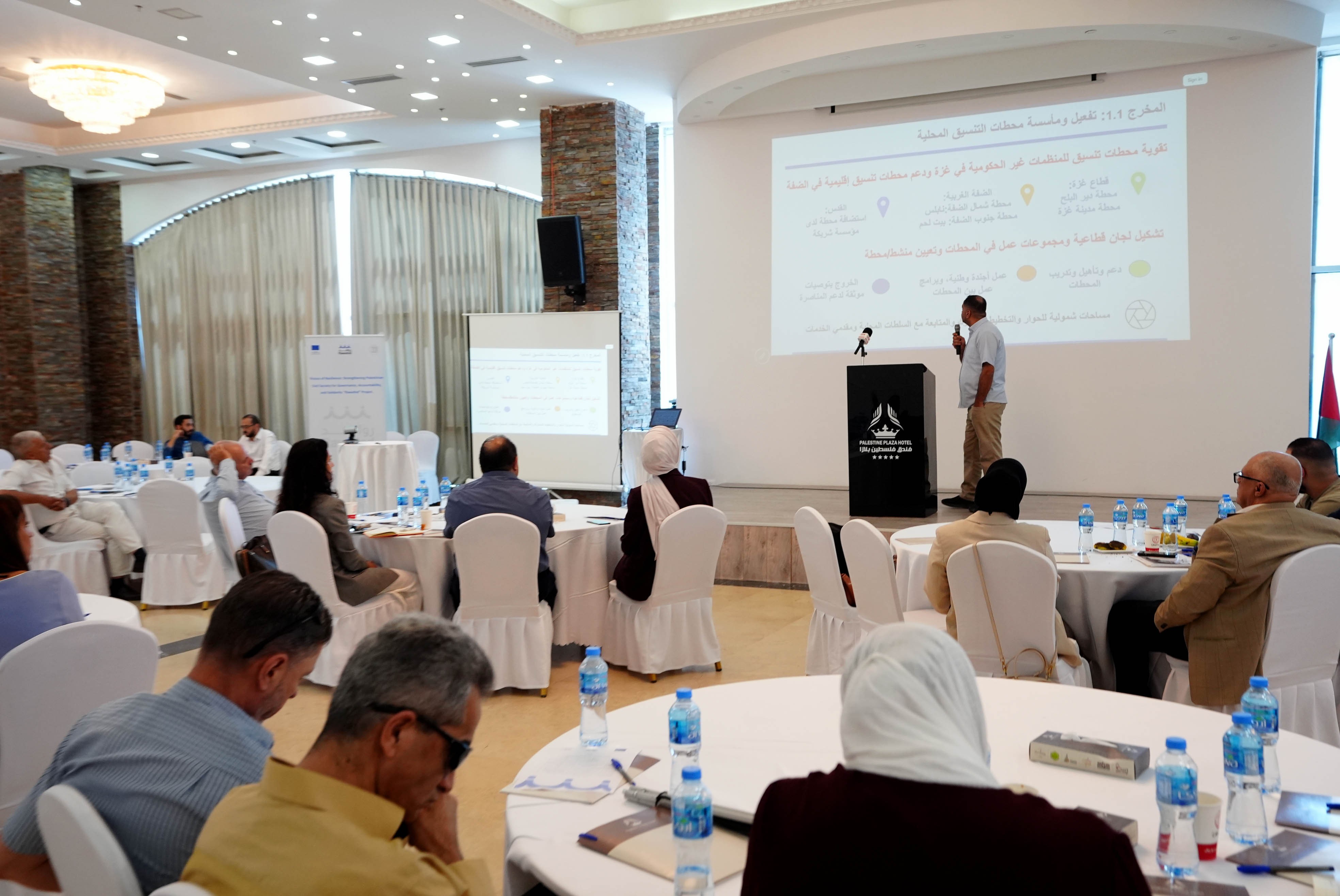
Nidal Jbaraeen, Acting Executive Director of the Network and Director of the Rawafed Project, provided a detailed explanation of the project, its orientations, phases, and working mechanisms, considering that it comes as an extension of the previous “Shorakaa” Project, also funded by the European Union. He explained its importance, particularly with the worsening catastrophic conditions resulting from the destructive war on the Gaza Strip and the restrictions imposed on Jerusalem and the West Bank, and the constraints placed on civil institutions, which require broadening partnership and joint action. He pointed to the establishment of local work coordination hubs scheduled during the project, which provide spaces for work, joint coordination, and dialogue, in addition to advocacy campaigns at the local, regional, and international levels. He also noted that the strategic objective of the project is to strengthen civil society organizations to protect the civic space and effectively defend civil liberties, and to advocate regionally and internationally within broad campaigns to mobilize international support and solidarity and influence decision-makers, in coordination with the European Union and by informing its members of the living conditions in the occupied Palestinian territory, through cross-border campaigns, the production of digital content, and exhibitions abroad.
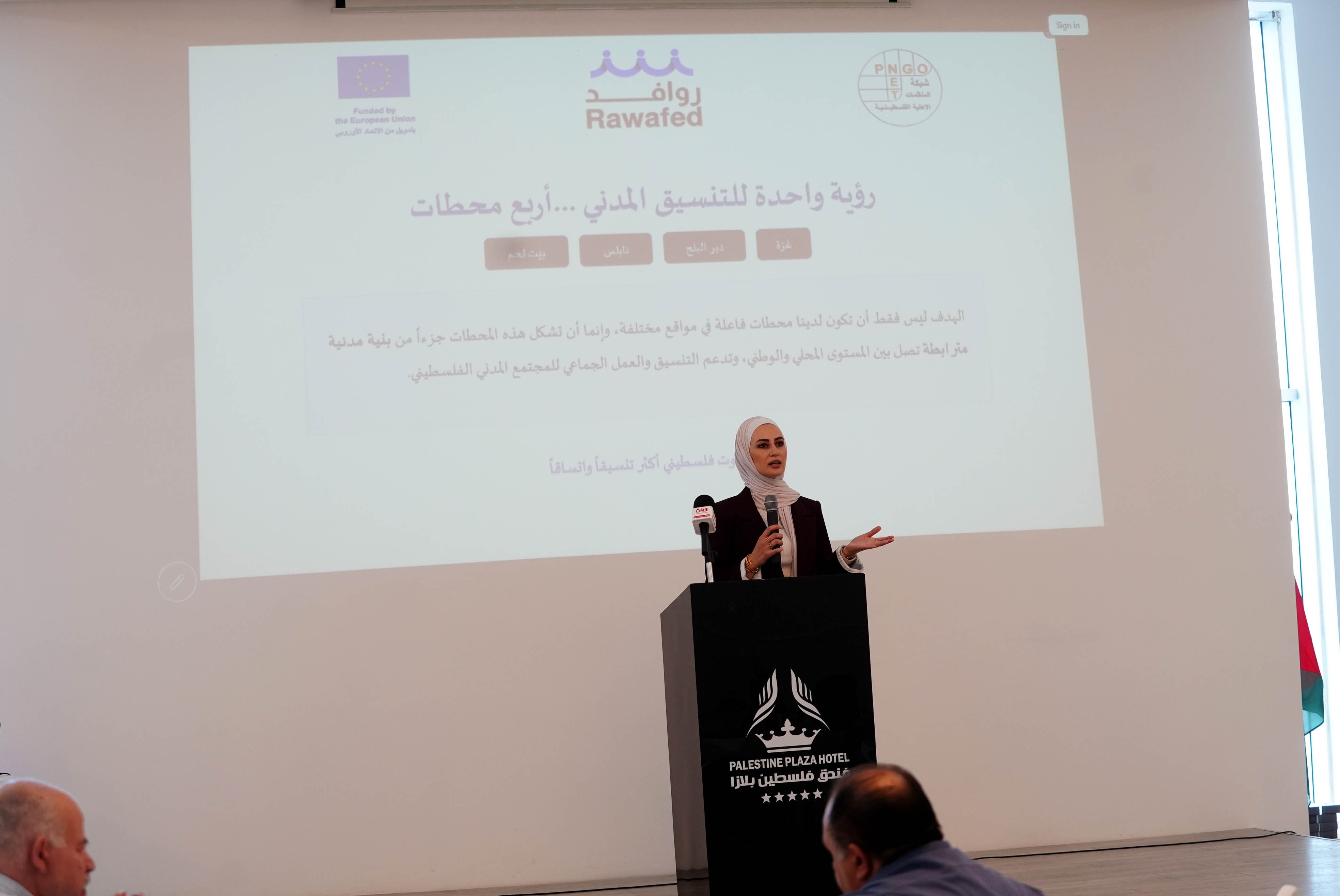
Ahed Boukraa, the Project Coordinator in Gaza, presented the key expectations for the work of the local coordination hubs, which will be located in both Gaza City and Deir al-Balah. These hubs will provide a space for planning, networking, and increasing the effectiveness of participation and coordination among civil institutions and grassroots groups, and for transitioning to opening a broad dialogue leading to the formulation of plans and programs, the drafting of joint positions and practical steps, and linking institutions in a manner that moves them from the realm of dialogue to the realm of systematic, evidence-based accountability, despite the difficulties experienced in the Gaza Strip.
Aya Marridi, the Project Coordinator in the West Bank, presented the concept of the Rawafed hubs as going beyond being a project being implemented to being a space for joint work and the elevation of the Palestinian civic voice, providing a space for identifying needs and priorities regarding local issues imposed by the current reality, and linking the discussion with the agenda of the Civil Society Coordination Council, which in turn provides channels and orientations for work from the grassroots to the top. The hubs will be in Nablus in the northern West Bank and Bethlehem in the south, serving as spaces that express shared visions linking the local level to the national level and increasing participatory engagement, in addition to a Jerusalem hub, and linking these hubs to serve civil society, its vision, and its objectives.
The introductory workshop, attended by 75 participants from various institutions, coalitions, and networks, concluded with numerous interventions, inquiries, and recommendations that will be addressed during the upcoming period of the project, which spans three years and includes numerous activities and events falling within its framework, under the guidance and supervision of the Civil Society Coordination Council as the broadest umbrella platform, whose membership includes institutions, unions, and associations with wide reach across the occupied Palestinian territory.