
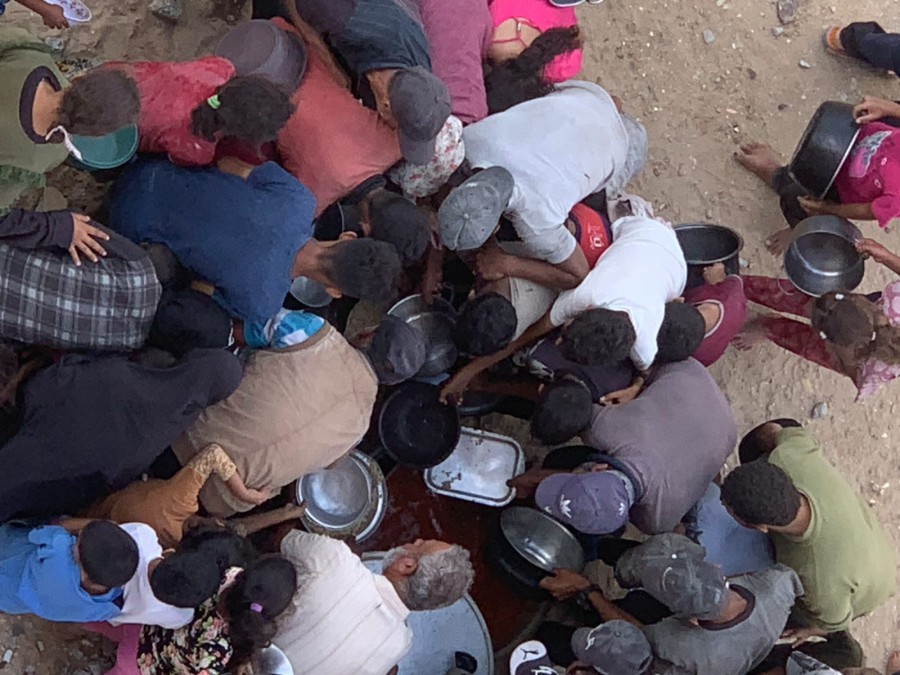
The international community marks World Food Day and the International Day for the Eradication of Poverty this year amid the ongoing crime of genocide in the Gaza Strip. More than two million people in the Gaza Strip continue to endure catastrophic conditions, even as the United Nations system renews its commitment to sustainable development and the fundamental human right to freedom from hunger. These stark contradictions unfold against a backdrop of a severe deterioration in food security and unprecedented levels of poverty across the Gaza Strip.
Israeli Occupying Forces (IOF) have systematically and continuously targeted the economic sectors across the governorates of the Gaza Strip. They have deliberately destroyed the industrial and commercial sectors by bombing industrial facilities and commercial establishments, while devastating the agricultural sector through the bulldozing of agricultural land and crops, the destruction of poultry farms and livestock holdings, including cattle, the prevention of fishing, and the destruction of aquaculture projects. Under fire, the IOF have taken control of approximately 67% of the Gaza Strip’s area and prohibited access to and use of natural resources in the areas under their control, particularly water resources and agricultural land. They have also paralysed industrial zones and production facilities, contributing to a sharp rise in unemployment, with approximately 74% of the workforce losing their jobs.
The crisis has been further exacerbated by the disruption of financial transfers following the suspension of banking operations and the closure of bank branches, which have been limited to providing administrative services without supplying cash to the Strip. Moreover, amid the IOF’s absolute control over the Gaza Strip’s crossings, imports and the entry of goods have been restricted to a limited list of items.
These measures have severely distorted the economy and transformed the market from a competitive environment into one dominated by oligopolistic practices. As a result, most residents of the Gaza Strip have been forced to rely on community kitchens and charitable food kitchens (takayas) to obtain food, while being engulfed by extreme poverty.
This fact sheet examines the humanitarian and livelihood consequences of the IOF’s deliberate use of food as a weapon, which has further deepened the poverty and extreme poverty endured by the population of the Gaza Strip. Drawing on official United Nations indicators, it seeks to analyse the humanitarian and living conditions in Gaza and demonstrate that the economic collapse, rising poverty and unemployment, and widespread food insecurity are not merely collateral consequences of the genocide. Rather, they are the inevitable outcome of a systematic plan that destroys the essential foundations of life and renders the Gaza Strip uninhabitable.


