
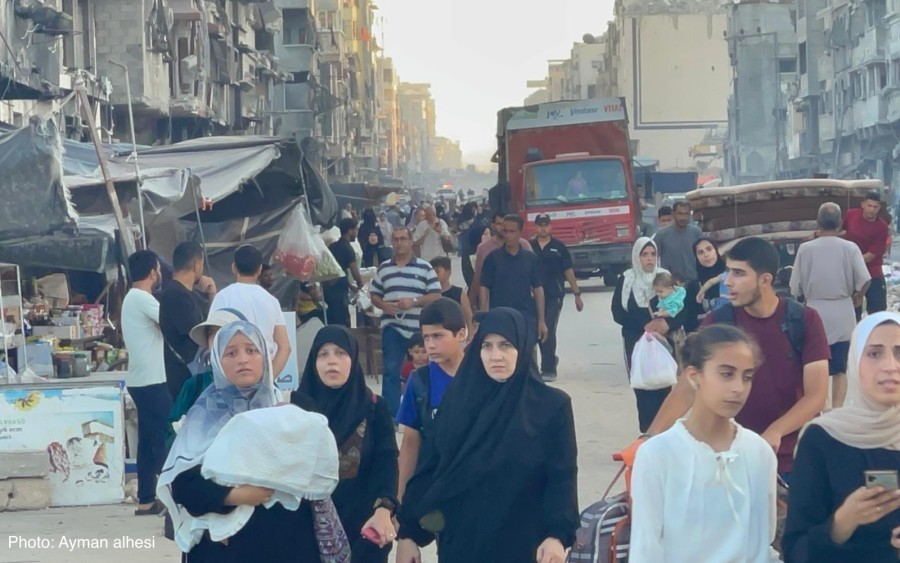
Wednesday, 25 November 2026, marks the International Day for the Elimination of Violence against Women, at a time when Palestinian women and girls continue to face multiple and intersecting forms of violence and violations. These take place amid the ongoing crime of genocide perpetrated by Israeli occupation forces despite the declared ceasefire, the deteriorating humanitarian and living conditions, and the escalation of settler attacks, demolitions, forced displacement, and restrictions imposed on Palestinians in the West Bank, including East Jerusalem.
This occasion underscores that combating violence against women cannot be confined to condemning violations and crimes or providing emergency humanitarian assistance. It requires effective protection for women and girls, ensuring that victims and survivors have access to justice and effective remedies, holding those responsible for crimes to account, and bringing impunity to an end.
Palestinian and UN statistics reveal the devastating toll of the war on the Gaza Strip on Palestinian women and girls. According to data published by the Palestinian Central Bureau of Statistics (PCBS) on 15 November 2026, approximately 12,400 women have been killed in the Gaza Strip, including more than 9,000 mothers. These figures represent far more than the human toll of the war. They reveal the profound loss suffered by women and their families, the breakdown of family ties, children losing their mothers, and other women being forced to shoulder the burden of caring for their families under exceptionally harsh conditions. UN Women estimates that approximately one million women and girls have been displaced, while nearly one-quarter of households in the Gaza Strip are now headed by women. These figures reflect the profound changes the war has imposed on family structures and the distribution of roles and responsibilities within households.
The impact of these violations extends beyond killing, injury, and displacement to encompass the daily living conditions that increasingly constrain women and girls and threaten their safety and dignity. Through testimonies provided by Palestinian women, Al Mezan Center for Human Rights has documented repeated waves of displacement that have forced women and their families to seek shelter in schools, displacement centres, overcrowded buildings, tents, and other accommodation lacking even the minimum standards of privacy, hygiene, and safe living conditions. In these circumstances, women have been left to shoulder growing responsibilities for securing food and water and caring for children, older persons, and the sick, while essential resources and services have dwindled and the capacity to provide protection and respond to their needs has been severely undermined.
The testimonies collected by the Center document the suffering of women forced to endure hunger and shortages of essential food supplies, and to search for water, purchase it, or travel long distances to obtain it. Meanwhile, their children have suffered from weight loss, diarrhoea, vomiting, skin diseases, and lice as a result of malnutrition and deteriorating hygiene and sanitation conditions. These circumstances go far beyond everyday hardship. They constitute compounding risk factors that threaten the physical and psychological health and safety of women and their children, while placing additional burdens on women who bear responsibility for meeting their families' basic needs amid the absence of adequate shelter and the resources necessary for a dignified life.
R.S., a 33-year-old widow from Nuseirat in the central Gaza Strip, whose husband was killed and who has two daughters aged six and four, stated:
"My children and I were displaced several times, for prolonged periods. I had to walk long distances to collect water and obtain food from community kitchens. I also spent hours waiting outside institutions to receive food parcels. My four-year-old daughter, D., suffered from malnutrition and recurring skin diseases because we were living in a tent by the sea in Al-Mawasi, Khan Younis. I could not afford to buy medication or provide clean water for her. I started looking for work to meet my children's needs and my own, but in Gaza, almost everything has become impossible."
The severity of these imposed conditions is particularly evident in their impact on women's health, especially pregnant and breastfeeding women and women of reproductive age. UN Women has reported approximately 4,000 cases of miscarriage during the first half of 2026, reflecting the deterioration of reproductive and maternal health conditions amid inadequate healthcare, insufficient nutrition, and persistently harsh humanitarian circumstances. Damage to healthcare facilities, shortages of medicines and medical supplies, and barriers to accessing specialised services expose women to additional risks and undermine their right to essential healthcare, including antenatal, childbirth, postnatal, and reproductive health services.
N.D., a 30-year-old married woman with a two-year-old daughter who is currently four months pregnant, stated:
"I gave birth to my first child during the first year of the war, while we were displaced. Most hospitals were not functioning. Immediately after giving birth, I had to walk back with my newborn, on foot and over rubble. After being displaced several times in Al-Mawasi, Khan Younis, and Deir al-Balah, I returned to what remained of my home in Al-Qarara, east of Khan Younis. We are forced to flee every few weeks as the army advances beyond the so-called 'yellow line'. I am now four months pregnant with my second child and have experienced bleeding on several occasions. However, because there are no medical centres in the eastern areas and no transportation available, I have to walk to medical facilities in Al-Mawasi, Khan Younis, or central Deir al-Balah. I need medication that I cannot obtain because of my limited financial means and the lack of free supplies."
This suffering is compounded by the deterioration of protection and psychosocial support services and the shrinking availability of safe spaces and specialised services for women and girls. According to the Gender-Based Violence Safety Audit published by the United Nations Population Fund (UNFPA) in September 2026, the risks facing women and girls in displacement sites and shelters intersect with overcrowding, lack of privacy, restrictions on movement, dependence on humanitarian assistance, and reduced access to services. These risks are particularly acute for adolescent girls, women with disabilities, older women, pregnant and breastfeeding women, and women without adequate family support. This underscores that providing shelter and assistance alone is insufficient to ensure protection unless the specific needs and privacy of women and girls are taken into account and safe, confidential, and accessible services are made available to them.
In the West Bank, including East Jerusalem, women and girls are also bearing the consequences of demolitions, forced displacement, settler attacks, and restrictions on movement and access to services and livelihoods. The impact of these violations is not confined to women directly subjected to them; it extends to their families and communities, undermining their ability to provide protection, care, and stability for their children. This is particularly evident in communities facing repeated displacement, violence, and attacks on properties and sources of livelihood. Across the Occupied Palestinian Territory, women are thus subjected to multiple forms of violence and deprivation, in which direct violations intersect with conditions that undermine their ability to exercise their fundamental rights.
Al Mezan Center for Human Rights stresses that protecting Palestinian women cannot be reduced to providing humanitarian assistance or responding to incidents of violence after they occur, important as these interventions may be. It requires addressing the root causes that expose women and girls to danger, including ending the crimes and violations targeting civilians and the conditions essential to their survival, and ensuring a safe environment in which they can exercise their rights without fear or discrimination.
The Center further stresses that harsh humanitarian conditions do not justify any form of domestic or community-based violence. Protecting women and girls requires strengthening prevention and response mechanisms and ensuring the availability of safe, confidential, and accessible healthcare, psychosocial, social, and legal services, while taking into account the diverse needs of women with disabilities, older women, pregnant and breastfeeding women, and survivors of violence.
Accordingly, Al Mezan Center for Human Rights calls on the international community, the United Nations, and the High Contracting Parties to the Geneva Conventions to fulfil their legal and moral obligations and take effective measures to:
- Take urgent and effective action to halt the genocidal war and protect Palestinian civilians, particularly women and girls; put an end to attacks and violations against them; and ensure respect for the rules of international humanitarian law and international human rights law.
- Ensure the unimpeded entry of humanitarian assistance and provide adequate shelter, water, food, fuel, and healthcare services. Healthcare facilities and sanitation infrastructure must be rehabilitated to ensure living conditions that safeguard the dignity and safety of women and girls, and guarantee that pregnant and breastfeeding women and women with specific healthcare needs have access to the care they require.
- Provide specialised and safe services for women and girls who have survived violence, including healthcare, psychosocial support, and legal assistance. Ensure the continued operation of safe spaces, shelters, and services dedicated to women and girls; secure the necessary resources for women's organisations and protection institutions; and strengthen their capacity to deliver sustainable, confidential, and accessible services.
- Guarantee women's and girls' access to justice and effective remedies; investigate violations and crimes committed against them, hold those responsible to account, and bring impunity to an end. Ensure that victims, survivors, and witnesses are not exposed to risks or reprisals, and provide effective avenues for reparation, compensation, and rehabilitation.
- Exert pressure to end the Israeli occupation of Palestinian territory, halt policies of forced displacement, settlement expansion, and collective punishment, and ensure the Palestinian people's right to self-determination. These measures are essential to dismantling the conditions in which violations and risks of violence continue to escalate, and to enabling women and girls to exercise their fundamental rights and freedoms.

