
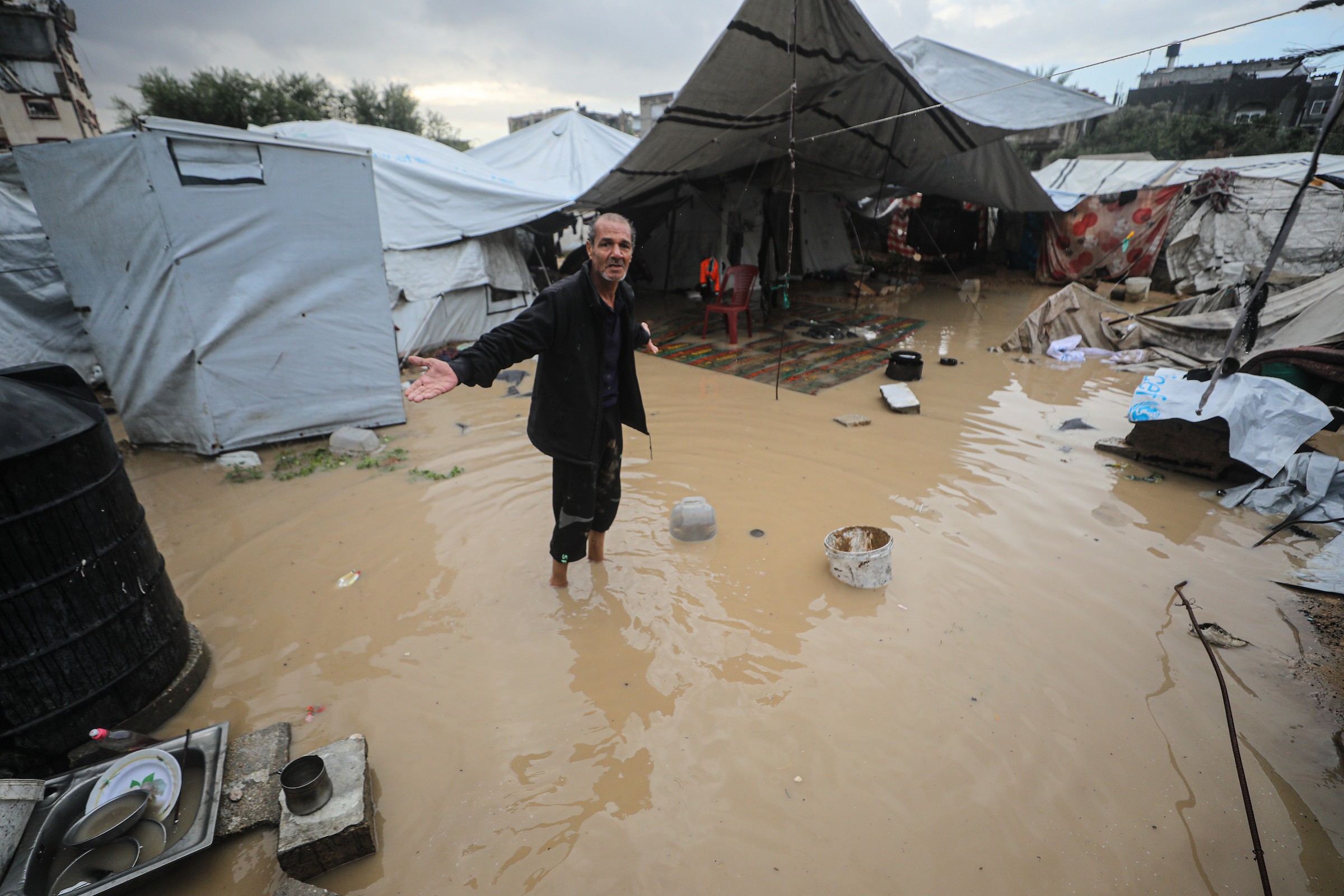
Gaza Floods as First Winter Storm Hits
Al Mezan Center for Human Rights strongly condemns the ongoing crimes committed against Palestinian civilians, who continue to endure multiple forms of suffering and violations that threaten their lives and human dignity, as well as the continued deterioration of humanitarian and living conditions across the Gaza Strip. The Center stresses that the flooding of displaced families’ tents as the first winter storms hit Gaza is neither unexpected nor unforeseen. Rather, it is the predictable consequence of conditions against which the Center has repeatedly warned, amid the continued denial of adequate shelter and the basic necessities of life to the population, and the international community’s persistent failure to take serious and effective measures to halt the ongoing genocide, now entering its fourth consecutive year.
The Center holds the international community responsible for allowing this catastrophic situation to persist and calls for urgent action to halt Israeli crimes, provide temporary housing and the materials necessary to protect displaced people from the cold and rain, and ensure the unimpeded delivery of humanitarian and relief assistance before the harsh winter conditions result in further casualties and loss of life.
Hundreds of thousands of displaced families continue to live in tents and makeshift shelters that fail to meet even the most basic safety standards. This is compounded by the widespread destruction of residential buildings and infrastructure, the limited space available for shelter, and the absence of safe alternatives. Rainfall has further exacerbated these families’ suffering, as tents become flooded and water accumulates in displacement sites, while damaged stormwater drainage and sewage networks compound the risks. These conditions threaten the safety of displaced people and create an environment conducive to worsening health and environmental hazards, particularly given the limited humanitarian response and the inadequacy of interventions to meet mounting needs.
Issam Younis, General Director of Al Mezan Center for Human Rights, stated:
“Israel continues to perpetrate the crime of genocide against the civilian population in the Gaza Strip, a crime that has been broadcast live for the fourth consecutive year. It is being carried out in multiple forms, through killing, destruction, starvation, and deprivation of water. Israel is deliberately subjecting civilians to exceptionally harsh conditions. We previously warned that winter was approaching, while more than 90 % of Gaza’s population is displaced, with most people living in dilapidated tents. The occupying power continues to exercise dangerous control over the entry of tents and essential supplies necessary for the population’s survival. This is happening amid the electricity blackout and the continued prohibition on the entry of fuel, heating materials, and equipment, all of which portend an imminent humanitarian catastrophe this winter.”
The shelter crisis is deepening as large numbers of tents accommodating hundreds of thousands of displaced people continue to deteriorate. Approximately 200,000 tents are estimated to be worn out and no longer provide even the minimum protection against cold and rain.[1] The risks are further heightened by the presence of thousands of tents in areas vulnerable to flash floods and inundation, including near valleys and waterways, rainwater accumulation zones, and coastal areas. Their occupants are consequently exposed to the dangers of flooding and torrents of rainwater, making it imperative to relocate these tents to safe alternative sites to which displaced families can move.
A displaced woman (I.K.), living with her husband and three children in Al-Mawasi, Deir al-Balah, reported:
“We lived in Al-Mawasi, Khan Younis, for nearly two years. Every winter, we would be flooded by rainwater and seawater overflowing into the area. Two months ago, we decided to move somewhere else so that the water would not flood our tent and destroy all our belongings. We were displaced to Deir al-Balah and thought we had managed to escape. But when the storm arrived yesterday and the rain started falling, our dilapidated tent flooded again. We spent the entire night, until morning, standing in the rain and trying to cover the tent with more plastic sheets and pieces of fabric to keep the water out and prevent the tent from being blown away by the strong winds. Our children nearly froze to death after their clothes and our blankets became soaked with rainwater. There is nowhere else for us to flee or seek shelter. Most people are living through the same suffering, and the worst part is that winter has only just begun.”
In the same context, estimates indicate that approximately 950,000 displaced people are living in sites exposed to varying degrees of flood risk, including more than 400,000 people in locations classified as high-risk areas.[2] This raises serious concerns about the escalating threats to displaced people’s lives and safety, particularly as they continue to lack safe and adequate shelter and the resources needed to protect them from severe weather conditions.
Ajith Sunghay, Head of the United Nations Human Rights Office in the Occupied Palestinian Territory, stated:
“This suffering must end. This is the fourth year of displacement for most Palestinians in Gaza, and the fourth winter they are spending in flimsy tents that cannot withstand the rain, while they have continued to endure bombardment throughout this period. Let this be the last winter they spend in such conditions.”[3]
The dangers posed by winter are not confined to families living in tents and temporary shelters. They also extend to thousands of people forced to live in damaged and structurally unsafe buildings in the absence of suitable alternative accommodation. During the previous winter, several buildings collapsed on their occupants, killing dozens of people. Currently, an estimated 44,000 people are living in more than 2,300 structurally unsafe buildings, while other estimates indicate that more than 4,000 buildings require total or partial demolition. Concerns for the lives of these residents intensify with rainfall and strong winds, which may further aggravate existing structural damage or cause parts of these buildings to collapse. This places occupants at direct risk, particularly given the absence of safe alternative accommodation to which they can relocate.
A resident (B.H.) of Al-Mawasi, Khan Younis, reported:
“I live with my family, my pregnant wife, and my young child in a dilapidated tent. I tried to prepare it before the start of winter, but within the first few minutes of rainfall last night, the tent was completely flooded. The tarpaulins I had used to reinforce it came loose, the covering on top was blown away, and rainwater poured inside. Our mattresses and blankets, which we rely on to keep warm, were soaked, and all our belongings got wet. We have nowhere dry to sit or take shelter from the rain.
“My wife is due to give birth, and I have a young child. We spent the entire night standing and trying to remove the water from the tent. I do not know how I will protect them from the cold and rain, especially since the tent could not even withstand half an hour of rainfall. I do not know how we will manage throughout this winter when it has barely begun. We have no means to repair or replace the tent, nor do we have anything to protect us from the cold and water.
“We have come to fear every rainfall as though it were another bombardment by the Israeli occupation forces, because there is nowhere for us to go or seek shelter. All we wish for is a place where we can be safe and protect our children from the cold and rain.”
Against this backdrop, the shelter crisis is being exacerbated by a severe shortage of the supplies and materials needed to repair, reinforce, and replace damaged tents, alongside continued restrictions on the entry of essential items required to withstand winter conditions. Approximately two million people remain in need of shelter assistance and non-food items. However, available supplies are sufficient to provide only partial assistance to approximately 52,000 families, out of a total of 294,250 families requiring shelter assistance during the rainy season. This represents only around 18 per cent of families in need. These figures highlight the widening gap between displaced people’s actual needs and the assistance available, severely undermining efforts to provide them with the necessary protection as weather conditions worsen.[4]
Al Mezan Center for Human Rights reiterates its condemnation of the ongoing genocide and the continued prevention of the entry of temporary housing units and shelter materials for displaced people in the Gaza Strip, as well as heavy machinery and infrastructure equipment, particularly as winter sets in. The Center warns of an escalating humanitarian and health catastrophe that threatens to trigger the spread of diseases and epidemics. Exposure to extreme cold also places civilians, particularly children, at risk of death from hypothermia, illness, and the collapse of residential buildings.
The Center underscores the international community’s responsibility for the atrocities endured by Gaza’s population and stresses the urgent need to exert pressure on the Israeli occupation forces to immediately open the crossings and allow the entry of equipment and materials necessary to mitigate the impact of impending winter storms. These measures are essential to control rainwater runoff, prevent tents from flooding, and address the dangers posed by rainwater mixing with damaged and non-functioning sewage networks. They are also necessary to establish safer living conditions for displaced people, particularly children, women, and older persons, who continue to face inhumane conditions that threaten their lives on a daily basis.
Accordingly, the Center calls on the international community to fulfil its legal and moral responsibilities towards the population of the Gaza Strip and take urgent action to ensure an end to the genocide, protect civilians from the adverse effects of winter weather, provide safe shelter for displaced people, and guarantee their access to essential services, with particular consideration for the needs of the most vulnerable groups. It further demands the immediate and permanent opening of the crossings to allow the entry of shelter materials, heavy machinery, and medical supplies, and to facilitate the rehabilitation of essential infrastructure necessary to preserve civilian lives across the Gaza Strip.
The Center further stresses the imperative of upholding the principles of accountability and ending impunity, including through the arrest of war criminals Benjamin Netanyahu and Yoav Gallant, against whom the International Criminal Court has issued arrest warrants, as well as all other Israelis who ordered or carried out crimes against civilians in the Gaza Strip and the rest of the Occupied Palestinian Territory. Allowing perpetrators to evade accountability only emboldens further violations and crimes.
[1] Gaza Municipality statement.
[2] OCHA, Humanitarian Situation Report, 15 October 2026.
[3] UN Human Rights Office report.
[4] Ibid., OCHA Humanitarian Situation Report, 15 October 2026.


