
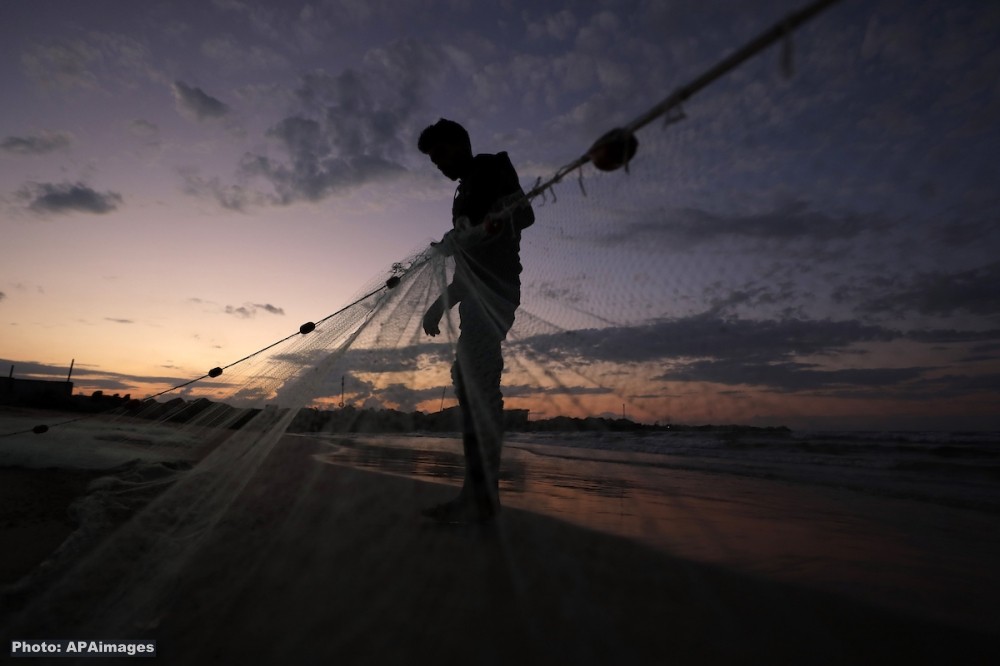
Israeli forces have escalated their violations against Palestinian fishermen in the Gaza Strip, detaining two fishermen this morning while they were aboard a fishing boat off the coast of Gaza Port. The fishermen are civilians protected under international law and must not be subjected to attacks or interference with their freedom to work in Palestinian territorial waters. At the same time, Israeli forces continue to prevent fishermen from accessing the sea to pursue their livelihoods for the third consecutive year, in a grave violation that deprives fishermen of access to their places of work, exacerbates their living conditions, and undermines their ability to provide for their families. This constitutes a continuation of the violations and grave crimes perpetrated by Israeli forces in the context of the ongoing genocidal war against the Gaza Strip.
According to field monitoring conducted by Al Mezan, at approximately 9:00 a.m. on Thursday, 20 August 2026, Israeli naval vessels attacked a majdaf fishing boat carrying four fishermen, opened fire at the boat, and intercepted it. The naval forces forced two of the fishermen to remove their clothes and enter the sea before detaining them. The two fishermen were identified as Yousef Zaher Abu Riala, 22, and Mohammad Saeed Al-Zahhar, 32, both residents of Al Shati Refugee Camp, west of Gaza City. They were subsequently taken to an undisclosed location.
In this context, Israeli forces have continued to impose a comprehensive maritime blockade on the Gaza Strip since October 2023, including preventing fishermen from accessing the open sea. As a result, fishermen have been forced to operate under extremely difficult conditions within a narrow area extending approximately one kilometre from the shoreline, using small Paddle boats (mijdaf). Even within this severely restricted area, fishermen remain exposed to gunfire, pursuit, detain, and, in some cases, killing and wounding.
During the genocidal war on the Gaza Strip, Israeli forces have destroyed approximately 95 % of the fishing sector. Israeli bombardment completely destroyed Gaza Port, including the fishing boats docked there, fishermen’s facilities, equipment, and infrastructure. Israeli forces also destroyed the port in Khan Younis Governorate and the fishing harbours in Rafah and North Gaza Governorates, while partially destroying the harbours in Al-Zawayda and Deir al-Balah.
Mr. Zakaria Bakr, Head of the General Union of Fishermen and Marine Production Workers, informed Al Mezan’s lawyer on 20 August 2026 that Israeli occupation authorities have killed 233 Palestinian fishermen during the genocidal war, either while they were attempting to fish at sea or while present in their homes and other locations. A further 140 fishermen have sustained injuries of varying degrees, while 130 fishermen have been detained, most of whom were subsequently released.
Al Mezan Center for Human Rights strongly condemns the Israeli violations and grave crimes committed against Palestinian fishermen and the fishing sector. The Center stresses that preventing fishermen from accessing the sea constitutes a form of collective punishment prohibited under international law. It further emphasizes that killing, inhumane acts, and unlawful detention constitute acts employed as part of the ongoing genocidal campaign against the Palestinian population in the Gaza Strip for the third consecutive year.
Accordingly, Al Mezan reiterates its call on the international community to fulfil its legal and moral responsibilities towards the population of the Occupied Palestinian Territory. The Center calls on international bodies entrusted with upholding and enforcing international law to take effective and meaningful measures to halt the ongoing genocide and grave Israeli crimes, ensure the protection of civilians, and guarantee accountability and prosecution of those responsible for violations, as well as those who ordered their commission. It further calls for justice for victims, including effective reparations and redress for the harm inflicted upon lives and property, as well as the geographical, maritime, environmental, agricultural, health, cultural, industrial, and other domains.


